
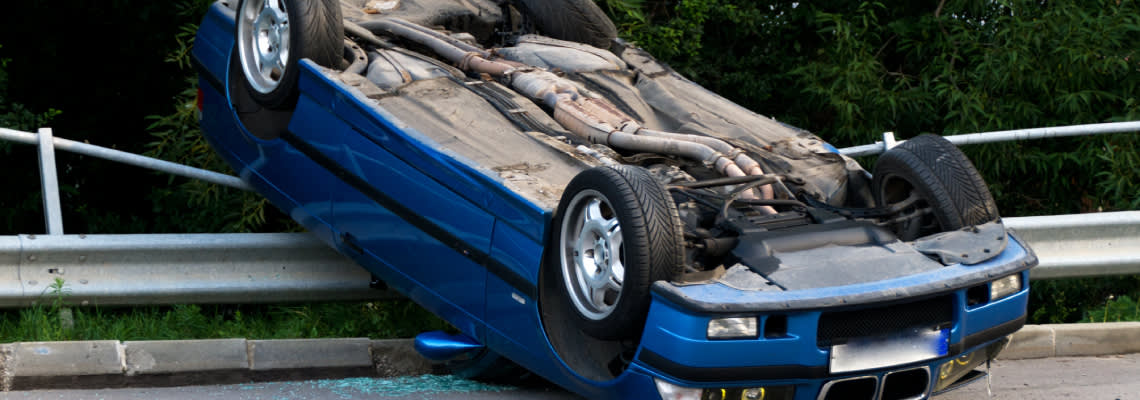
Rollover Accidents Involving Roof Crush: Holding Manufacturers Liable Under NHTSA’s Roof-Strength Standards
In a rollover, the roof is one of the structures standing between you and a devastating injury. But if it buckles inward, the part of the vehicle meant to preserve the space around you can become part of what causes the harm. A defective roof that collapses during a rollover may contribute to serious head, neck, or spinal injuries, and the manufacturer may potentially be liable when that defect contributes to your injuries.
The damage left behind after a rollover can make a crushed roof seem like an unavoidable consequence of the crash. It may not be. If you were injured in Richmond or elsewhere in Central Virginia, our attorneys at Schilling & Esposito PLLC can examine what happened to the vehicle during the rollover and whether a structural defect may have made your injuries worse.
NHTSA Requires Vehicle Roofs to Meet Strength Standards
Vehicle roofs are subject to federal safety requirements intended to reduce deaths and injuries caused by roof intrusion during rollovers. Federal Motor Vehicle Safety Standard (FMVSS) No. 216a establishes minimum roof-crush resistance requirements for covered passenger vehicles.
Under NHTSA’s roof-crush requirements, covered vehicles with a gross vehicle weight rating of 6,000 pounds or less must withstand a test force of up to three times the vehicle’s unloaded weight. Covered vehicles weighing more than 6,000 pounds and up to 10,000 pounds must withstand up to 1.5 times their unloaded weight.
The test applies force to one side of the roof and then the other. The standard also limits how far the testing plate can move into the roof and includes a requirement intended to preserve space around an occupant’s head.
Not every vehicle is subject to identical requirements. FMVSS No. 216a includes exceptions and special provisions for certain vehicles, so the make, model, weight classification, configuration, and other characteristics of the vehicle matter when determining which requirements apply.
A Crushed Roof Alone Does Not Prove a Defect
Seeing a roof pushed deeply into the passenger compartment can raise serious questions, but the vehicle's appearance alone does not establish manufacturer liability. Rollovers can subject vehicles to substantial forces, and a damaged roof is not automatically defective.
Under Virginia product liability law, the evidence generally must establish that the product was unreasonably dangerous for its ordinary or reasonably foreseeable use. Depending on the facts, a product may be unreasonably dangerous because of its design, manufacture, or assembly, or inadequate warnings.
For a roof crush claim, a much closer examination of what failed and why is required. The roof structure, pillars, welds, materials, and other vehicle systems will all be considered in the post-accident analysis. Further technical analysis may also be necessary to determine how the roof moved during the rollover and whether that movement contributed to your injuries.
That is why rollover accident claims in Virginia involving suspected vehicle defects can require a different investigation from a collision claim focused solely on another driver’s negligence.
Can a Manufacturer Still Be Liable if the Vehicle Met Federal Standards?
Yes. Meeting an applicable federal motor-vehicle safety standard does not automatically protect a manufacturer from common-law liability.
Federal law expressly provides that compliance with a motor vehicle safety standard does not exempt a person from common law liability. In other words, NHTSA standards establish federal safety requirements, but compliance alone does not determine whether a manufacturer can be held liable for an alleged defect.
The reverse also requires care. A badly crushed roof does not automatically establish liability simply because it appears it should have performed better. The applicable safety requirements, the alleged defect, the mechanics of the rollover, and the connection between the roof failure and your injuries must all be considered.
The Vehicle Itself Can Hold Important Evidence
After a serious rollover, getting rid of a badly damaged vehicle may seem like the obvious next step. When roof crush or another possible vehicle defect is involved, however, the vehicle may be one of the most valuable pieces of evidence available.
Its condition can help specialists examine where and how the roof deformed. Depending on the case, investigators may also consider photographs and videos, crash-scene evidence, vehicle specifications, repair and maintenance records, witness accounts, medical records, and available electronic vehicle data.
Together, that evidence may help reconstruct both the rollover and what happened to you inside the vehicle. For that reason, repairing, selling, scrapping, or substantially altering the vehicle before a potential defect has been evaluated can create problems. Preserving it may allow physical evidence to be examined before it disappears.
How Our Rollover Accident Attorneys in Richmond, Virginia, Can Help
A rollover can leave you facing serious injuries, medical treatment, time away from work, and a vehicle damaged almost beyond recognition. Knowing that another driver caused the crash may answer only one part of what happened. If the roof collapsed around you, there may also be a question about whether the vehicle itself failed to protect you as it should have.
At Schilling & Esposito PLLC, our attorneys, Tom Schilling and Mark Mario Esposito, can examine the circumstances of a serious rollover, the available evidence, and questions involving a possible vehicle defect. We can also help you understand what evidence may need to be preserved and what potential sources of liability should be investigated.
If you were injured in Richmond or elsewhere in Central Virginia and believe roof collapse contributed to your injuries, don't assume that the condition of the vehicle was simply an inevitable result of the rollover. Our attorneys can examine what happened and help you determine your next steps. Contact us today to schedule a consultation.